
Artificial Grass FAQ
Artificial Grass FAQ & Buying Guide
Everything you need to know before buying — from pile heights and GSM to installation, maintenance, and UK-wide delivery.
General Questions
How long does artificial grass last?
Most quality artificial grass lasts between 10 and 20 years depending on usage, foot traffic, and how well it is maintained. All grasses in The Grass Yard range come with a manufacturer's guarantee.
Will artificial grass fade in sunlight?
No. The full range at The Grass Yard is UV stabilised, meaning the colour will not fade regardless of sun exposure — even in prolonged periods of direct sunlight.
Is artificial grass safe for children?
Yes. Artificial grass is hypoallergenic and free from pesticides and herbicides. It is also more comfortable to play on than natural grass in wet or muddy conditions, and much easier to clean up after.
Is artificial grass suitable for pets?
Yes. The entire range is pet-friendly — it's easy to rinse clean, doesn't harbour mud, and is more resilient than natural turf. The Grass Yard supplies both a general artificial grass cleaner and a pet-specific deodoriser to keep pet areas fresh and hygienic.
Does artificial grass get hot in summer?
Artificial grass can warm up in direct sunlight more than natural grass. A quick spray of water will cool it down almost instantly. Grasses with lighter tones and higher drainage rates tend to stay cooler underfoot.
Buying Guide
What pile height should I choose?
Pile height is largely personal preference, but bigger isn't always better. A 50mm pile is luxuriously soft for lounging but can flatten underfoot with heavy use. For families with children or dogs, a 30–40mm pile tends to be more practical and durable. The key is to focus on density (GSM) first — a denser grass at 30mm will often outperform a less dense grass at 50mm.
What is GSM and why does it matter?
GSM stands for grams per square metre — a measure of how densely the fibres are packed into the grass. A higher GSM means more fibre per square metre, which generally means better quality, better appearance, and a longer lifespan. GSM is often a more useful buying metric than pile height alone.
What colour artificial grass should I choose?
Artificial grass comes in a range of green tones from olive through to lime. A natural-looking lawn usually benefits from a brown fleck (known as thatch or root zone) woven through the fibres. For north-facing gardens with less light, a lighter shade of green will lift the space. Darker greens work well in bright, south-facing gardens. Ordering samples and viewing them outdoors in natural daylight is the best way to make the right call.
What widths and lengths does artificial grass come in?
The Grass Yard's full roll range is available in 2m, 4m, and 5m widths, with standard roll lengths of 25m and 30m. Offcuts and roll ends are also available in the clearance section, ideal for smaller garden projects or patios.
Is there a minimum order?
No. The Grass Yard does not apply a minimum order for artificial grass or accessories — you can order exactly the quantity your project requires.
How much does artificial grass cost?
The range starts from £8.99 per m². Premium ranges offer increased density, a more natural appearance, and longer pile life. Ordering a free sample pack first is the best way to compare quality before committing.
Can I get free samples before I buy?
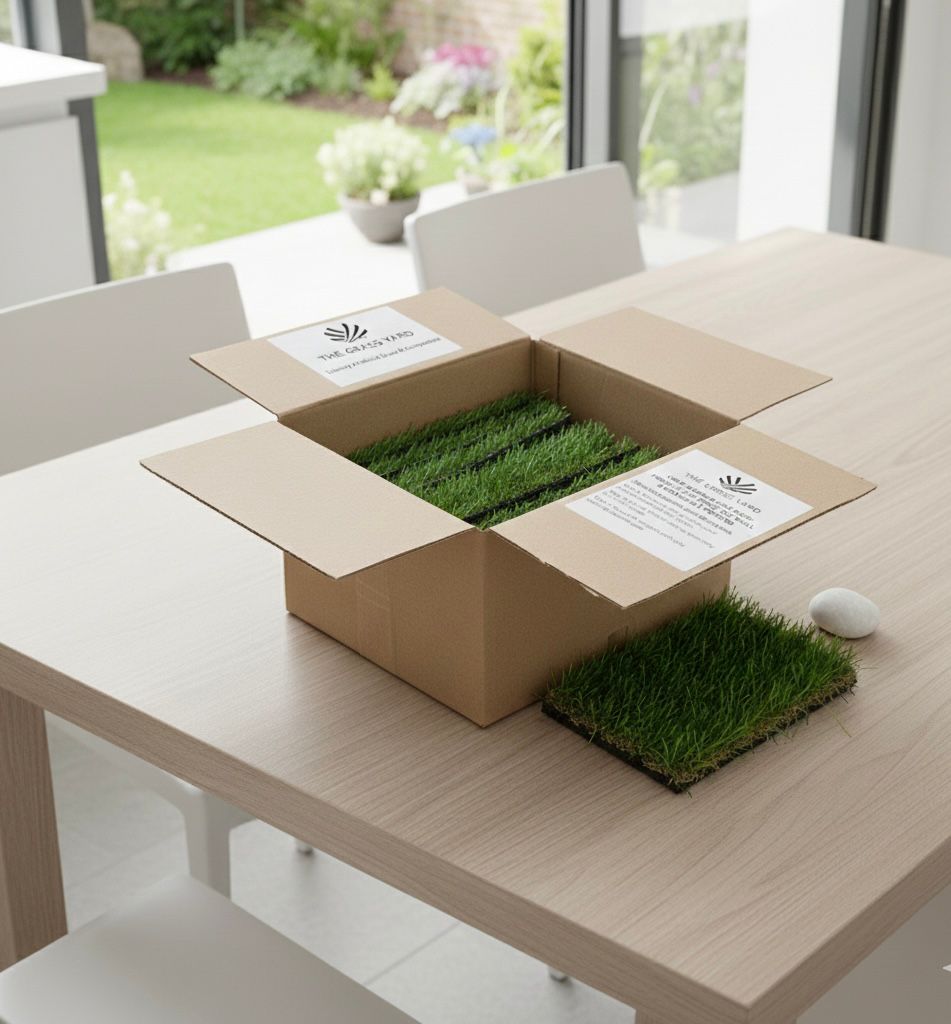
Yes. Sample packs are available to order online for £2.99 delivery, or to collect in-store from the Paisley showroom near Glasgow Airport. Each pack includes samples from across the range — Westray, Canna, Arran, Scalloway, Ailsa Craig, Shetland, and St Kilda.
Delivery
How long does delivery take?
Orders to Scotland are typically delivered within 1–2 working days. Deliveries to England and Wales take 2–3 working days. For island postcodes or remote locations, contact the team on 0141 237 4292 for an accurate estimate.
Do you deliver across the UK?
Yes. The Grass Yard delivers artificial grass and accessories UK-wide from its base in Paisley, near Glasgow. Both retail and trade orders are welcome.
Installation
Can I lay artificial grass myself?
Yes. For a competent DIY'er with the right preparation, artificial grass is a very achievable installation that can save a significant amount on labour costs. The Grass Yard provides full step-by-step installation guides, and the team is available by phone to advise throughout your project.
How do I lay artificial grass on soil?
The process involves stripping out the existing turf to a depth of 75–150mm (deeper for clay soils), compacting the base, laying a weed membrane, adding and compacting a sub-base of MOT Type 1 aggregate, then rolling out and securing the grass. The Grass Yard's full installation guide covers every step in detail.
Can artificial grass be laid on concrete or paving?
Yes — and this is an increasingly popular option as it avoids major excavation. Clean and prepare the surface, lay a foam shock pad for cushioning and drainage, then glue the artificial grass on top. Cracks under 15mm can be filled with mortar; larger cracks should be repaired before installation begins.
Which direction should artificial grass face?
Ideally, the pile should face toward your primary viewing point — usually looking out from the house. This gives the most natural, lush appearance. Laying across the pile is acceptable where garden dimensions make the ideal direction impractical.
Maintenance
Does artificial grass require maintenance?
Very little, compared to natural grass. Removing autumn leaves, brushing the pile periodically to keep it upright, and rinsing away pet mess are the main tasks. No mowing, watering, feeding, scarifying, or aerating is ever required.
How do I clean artificial grass?
A stiff brush and occasional rinse with a garden hose is sufficient for general upkeep. For pet areas, The Grass Yard's artificial grass cleaner and pet-specific deodoriser are recommended to eliminate odours and keep the surface hygienic.
Can artificial grass sections be joined?
Yes. Sections are joined using seam tape and adhesive. When done correctly the join is largely invisible. The Grass Yard has a dedicated guide on joining and seaming, and the team can advise on the best method for your project.
Still have a question?
Call the team on 0141 237 4292, visit the showroom in Paisley, or order a free sample pack to compare at home before you buy.